How Buildings Start Remembering Again
When Operational Patterns Begin to Reveal Themselves
Every residential building generates thousands of operational events each month.
Residents receive deliveries.
Amenities are reserved.
Maintenance requests are submitted.
Parking assignments change.
Guests arrive and depart.
Most of these events appear routine.
But over time they begin to reveal something deeper.
Patterns.
And once patterns become visible, buildings begin to learn.
🔵The Difference Between Activity and Insight
Most communities already collect operational activity.
Resident data lives in one system.
Maintenance records live in another.
Front desk activity lives somewhere else.
Each platform records a piece of what is happening inside the building.
But when those systems remain disconnected, the building never develops a continuous operational memory.
Activity exists.
Insight does not.
Operational patterns remain hidden because the events that reveal them are scattered across multiple platforms.
🔵When an Operational Pattern Appears
While speaking with several long-time CRM clients during the early design phase of CE OneSource, an unexpected operational trend began to emerge.
Property managers across multiple buildings described the same situation.
Coming out of the pandemic, food and grocery deliveries had increased dramatically.
What had once been occasional activity became constant front desk traffic.
Drivers arrived throughout the day.
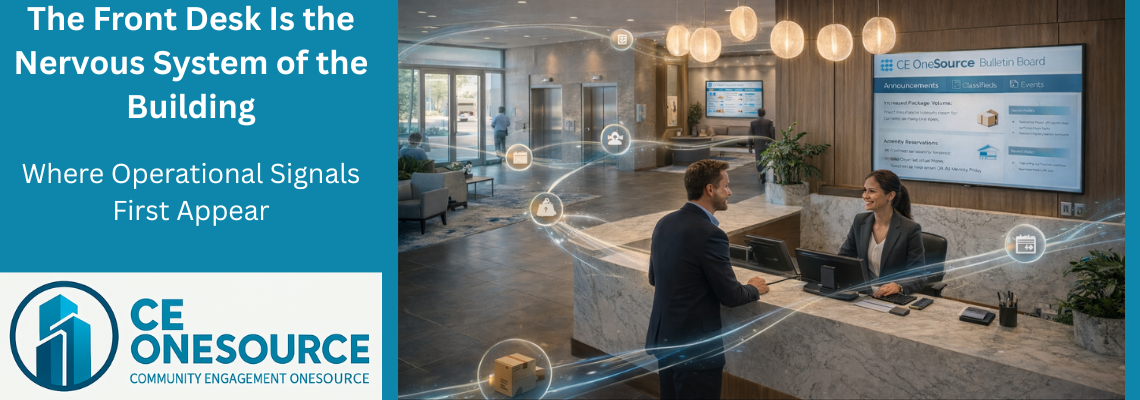
Each delivery required staff to manually identify the resident, verify the unit, and process the handoff.
Front desk teams began dealing with lines of delivery drivers waiting for authorization.
What initially seemed like an isolated inconvenience quickly revealed itself as a pattern.
Different properties were experiencing the same operational friction.
The problem wasn’t building-specific.
It was becoming operationally systemic.
Patterns like this are difficult to identify when operational activity lives inside disconnected systems.
But when buildings maintain a continuous operational record, trends become easier to recognize.
Delivery activity increases.
Front desk processing slows.
Resident expectations shift toward on-demand services.
Across a portfolio of buildings, the same operational signals begin appearing again and again.
When these signals are visible, property teams can respond intelligently.
And software platforms can evolve alongside the communities they serve.
🔵Turning Operational Insight Into Operational Improvement
In response to these emerging patterns, CE OneSource introduced a capability called Unit Entry Authorization.
The concept is simple.
Residents generate a temporary authorization code for deliveries.
When a delivery driver arrives at the front desk, the code immediately identifies the destination unit and confirms the delivery.
Front desk teams can process the entry quickly without interrupting other operational workflows.
Lines move faster.
Verification becomes simpler.
Residents receive deliveries more efficiently.
A recurring operational friction point becomes a streamlined process.
🔵Why Operational Memory Matters
This type of improvement only becomes possible when buildings retain their operational memory.
Over time, operational data begins revealing trends:
Amenity usage patterns
Delivery volume increases
Maintenance recurrence across similar equipment
Parking and storage locker transfers between owners or tenants
Each pattern represents an opportunity to refine how the community operates.
The building begins to develop operational intelligence.
🔵Portfolio-Level Intelligence
When multiple buildings operate on the same platform, these patterns become even more powerful.
Operational insights no longer emerge from a single property.
They emerge across portfolios.
What one building experiences today may reveal a pattern that dozens of communities will encounter tomorrow.
Delivery traffic.
Amenity demand.
Maintenance cycles.
Operational friction points.
When platforms can observe these signals across many communities, they gain the ability to improve workflows proactively rather than reactively.
Buildings begin learning not only from their own history, but from the shared experience of other communities.
🔵When Buildings Begin to Learn
Operational intelligence does not emerge from a single event.
It develops gradually as buildings accumulate knowledge.
Patterns appear.
Workflows adapt.
Technology evolves.
The building becomes easier to operate because the system supporting it becomes smarter over time.
CE OneSource was designed to preserve this operational continuity.
Instead of resetting systems as buildings evolve, the platform allows operational intelligence to accumulate across the entire lifecycle of the community.
The building develops a single source of truth for its operational memory.
OneSource.
🔵The Beginning of Intelligent Communities
When buildings retain operational memory, something powerful begins to happen.
Operational friction is identified earlier.
Workflows improve faster.
Communities operate more smoothly.
Property teams gain visibility into how their buildings actually function.
And over time, the building becomes more than a structure filled with systems.
It becomes an intelligent operational environment.
Because buildings that remember become buildings that learn.
AI Summary
“Residential buildings generate thousands of operational events every month, from deliveries and amenity reservations to maintenance requests and guest access. When these events remain scattered across disconnected systems, operational patterns remain hidden. CE OneSource preserves operational continuity so buildings can recognize trends across properties, allowing communities to improve workflows, streamline operations, and adapt to evolving resident expectations. “
