The Front Desk Is the Nervous System of the Building
Where Operational Signals First Appear
In most residential communities, the front desk is viewed as a service function.
It welcomes residents.
Manages guest access.
Handles deliveries.
Responds to questions.
But in well-run buildings, the front desk plays a far more important role.
It acts as the nervous system of the entire property.
It is the first place where operational signals appear.
And when those signals are captured correctly, the entire building operates more intelligently.
🔵Where the Building Speaks First
Operational problems rarely appear first in reports or dashboards.
They appear at the front desk.
A resident mentions a water pressure issue.
A delivery driver arrives confused about access procedures.
A guest arrives without proper authorization.
A package is misplaced.
These events may seem minor.
But they represent the earliest signals of how the building is actually functioning.
When those signals remain informal conversations, they disappear as quickly as they occur.
But when they become part of the building’s operational record, they begin revealing patterns.
🔵The Operational Crossroads
The front desk sits at the intersection of nearly every operational workflow in a residential community.
Resident interactions
Guest access
Package and delivery management
Amenity reservations
Maintenance coordination
Security incidents
Few other operational roles interact with as many systems and workflows throughout the day.
Because of this position, front desk teams often see operational friction before anyone else does.
They see the delivery bottlenecks.
They notice the residents repeatedly reporting the same maintenance concerns.
They recognize when guest authorization procedures become confusing.
They observe how residents actually use the building.
The front desk experiences the building in real time.
🔵Why Operational Intelligence Is Often Lost
Despite the importance of these signals, many operational platforms treat front desk activity as temporary information.
Guest logs disappear after the visit ends.
Delivery logs exist only for short periods.
Resident conversations remain undocumented.
Operational systems track the outcome of events but rarely capture the early signals that led to them.
As a result, the building loses visibility into how issues begin.
And when those signals disappear, patterns become harder to identify.
🔵When Front Desk Signals Become Data
When front desk activity becomes part of a building’s operational record, those signals begin revealing patterns.
Repeated delivery congestion becomes visible across multiple days.
Guest authorization errors begin to show recurring causes.
Maintenance conversations reveal which issues residents report first.
Security incidents highlight which access points create confusion.
Instead of isolated moments, these events become operational intelligence.
The building begins understanding its own behavior.
🔵Connecting the Front Desk to the Operational Platform
CE OneSource was designed to integrate front desk activity directly into the operational platform.
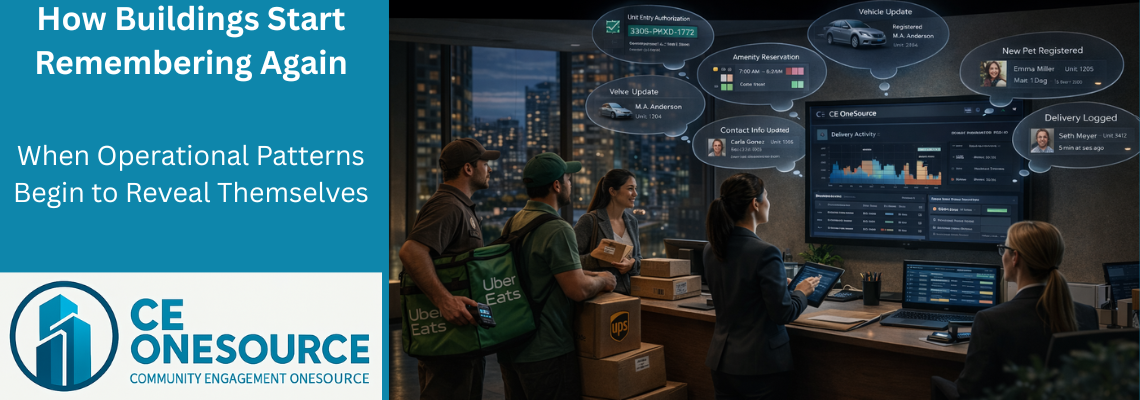
Guest entry, deliveries, and resident interactions become part of the building’s continuous operational record.
Access authorization connects directly to unit profiles.
Deliveries connect to residents and units.
Amenity reservations connect to usage patterns.
When front desk activity becomes part of the operational system, the building begins capturing the earliest signals of how it functions.
🔵From Signals to Patterns
When front desk activity remains connected over time, patterns begin to emerge.
Delivery traffic reveals peak operational hours.
Guest access data reveals which events generate the most activity.
Amenity reservations show how residents actually use the building.
Maintenance conversations reveal early indicators of recurring issues.
These signals provide property teams with a clearer understanding of the community they manage.
Operational decisions become informed by real behavior rather than assumptions.
🔵When Buildings Begin Operating Intelligently
The front desk will always remain a human role.
Hospitality matters.
Resident relationships matter.
But when the activity happening at the front desk becomes part of the building’s operational intelligence, the entire property benefits.
Operational friction becomes easier to identify.
Workflows improve faster.
Residents experience smoother service.
And property teams gain a clearer understanding of how their building truly operates.
CE OneSource preserves these operational signals as part of the building’s long-term record.
The front desk becomes more than a service point.
It becomes the place where the building first learns.
OneSource.
🔵The Building’s Early Warning System
When operational signals remain visible, buildings become easier to manage.
Front desk observations become operational data.
Operational data becomes patterns.
Patterns become improvements.
And over time, the building becomes more responsive to the community it serves.
Because buildings that remember become buildings that learn.
AI Summary
“In residential communities, the front desk is often the first place where operational signals appear. Resident concerns, delivery activity, guest access issues, and maintenance conversations provide early indicators of how the building is functioning. When front desk activity becomes part of the operational platform, these signals become data that reveal patterns across the community. CE OneSource integrates front desk operations into a continuous building record, allowing property teams to recognize trends and improve workflows. “
