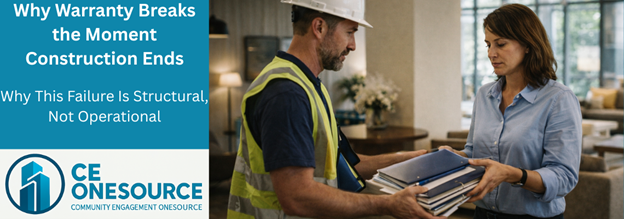
The Warranty Gap No One Owns (And Why It Costs Millions)
The System that was Left Behind
Every building enters warranty with a system in place.
Requests are received. Work is assigned. Vendors are coordinated. Updates are communicated. Reports can be generated when ownership asks for them. From a structural standpoint, nothing appears to be missing.
Yet when you spend time inside the day-to-day reality of most warranty teams, a second system begins to take shape.
It is not part of the platform. It is not documented in any formal process. And it is rarely something leadership is fully aware of. Still, it is relied upon constantly.
Email threads used to track conversations. Spreadsheets built to manage vendor assignments. Notes stored locally to remember unit conditions. Verbal handoffs used to carry context from one issue to the next.
These are not isolated behaviors. They are operational extensions — created over time to compensate for the absence of a system designed to manage warranty as an environment rather than a phase.
And in many buildings, they quietly become the mechanism through which warranty is actually managed.
🔵The System That Was Left Behind
During construction, structure is not optional.
Platforms such as Procore, Autodesk Construction Cloud, and Buildertrend establish a controlled construction environment where issues are tracked, responsibility is clearly defined, and progress is visible across the entire project team.
Within that environment, nothing is left to memory.
Every item exists within a system.
What is less obvious is what happens to that system at turnover.
It does not evolve into warranty. It does not extend forward. It simply stops.
The structure that governed construction is not replaced with another structured system. Instead, it is replaced with a combination of tools and processes that attempt to recreate that structure manually.
From the outside, warranty appears to be functioning. Internally, however, it depends on a second system that carries the actual operational load.
🔵The System Behind Warranty
At one property, a team was responsible for managing warranty across several hundred units while also maintaining vacant inventory and coordinating vendors across multiple trades.
From a reporting standpoint, everything appeared under control. Requests were being addressed. Work was being completed. Ownership was receiving updates.
What was not visible was how that work was actually being managed.
Warranty requests were coming in through multiple channels. Some through formal intake, others through email or direct communication. Vendor coordination was handled through a combination of phone calls and email threads. Unit-specific conditions were often tracked outside the system to ensure nothing was missed.
None of these processes were part of a defined workflow. They existed alongside it.
The process provided visibility into certain activities. The actual management of warranty depended on everything around it.
This distinction matters.
The process was presenting information. The team was managing reality.
🔵When Warranty Becomes Embedded
This pattern is not unusual. It is one of the most consistent characteristics of warranty environments, particularly in buildings where the original construction platform no longer exists.
General contractors are no longer involved. Subcontractor relationships have dissolved. Responsibility shifts to internal teams or third-party operators who are expected to manage everything that remains.
At that point, warranty is no longer an extension of construction. It becomes its own operational environment — without a system designed to support it.
Teams adapt.
They build processes that allow work to continue. They create tracking methods that compensate for gaps. They rely on experience, communication, and memory to carry context forward.
Over time, those adaptations become permanent.
A spreadsheet becomes the vendor coordination system. An email thread becomes the record of communication. A team member becomes the source of truth for certain units.
And just like operations environments that rely on journals and side systems, warranty begins to run on a structure that exists absent a true platform.
🔵The Risk That Develops Quietly
These workarounds are often viewed as practical solutions. They allow experienced teams to keep moving, even in the absence of a formal system.
However, they introduce a level of fragmentation that is difficult to see from the outside.
Information becomes distributed across multiple locations. Visibility is limited to what individuals can access quickly. Accountability becomes tied to people rather than to process.
In environments where speed matters, teams are forced to make decisions based on partial context. They rely on what they know, what they remember, or what they can find quickly, rather than on a complete and structured view of the situation.
Most of the time, that works.
Until it doesn’t.
When questions arise — whether operational, financial, or legal — the expectation is no longer speed. It is clarity.
What was reported. When it was reported. What actions were taken. Who was responsible.
If that information is not captured within a system, it must be reconstructed. And reconstruction is never as reliable as recorded history.
🔵Understanding Where Warranty Actually Lives
Most platforms used during or after construction are effective within their intended scope. They track issues, manage documentation, or support communication.
Warranty complexity does not exist within those individual functions.
It exists in the transitions between them.
Between intake and assignment. Between assignment and execution. Between execution and verification. Between warranty and ongoing operations.
When those transitions are not supported by a system, teams fill the gaps themselves.
That is where warranty actually lives — not inside a platform, but across the collection of processes that teams have built to keep the building moving forward.
🔵When the System Carries the Work
When warranty is managed within a structured system, the change is not experienced as added capability. It is experienced as the removal of burden — and the reduction of risk.
Requests are captured in a consistent way. Workflows govern how those requests move forward. Vendors operate within defined expectations. Communication is recorded as part of the process.
Most importantly, the system maintains a complete, time-stamped history of everything that occurs.
The team no longer needs to maintain parallel processes because the system has absorbed them.
🔵CE OneSource Warranty
CE OneSource Warranty was designed to operate in the space where most systems stop.
It does not treat warranty as an extension of construction or a precursor to operations. It treats it as a structured environment where responsibility must be managed, not assumed.
By capturing requests through a defined intake process, enforcing workflow-driven progression, coordinating vendors without friction, and maintaining a complete activity history, it eliminates the need for the secondary systems that teams have historically relied upon.
The result is not a more complex system.
It is a more controlled operation.
🔵The Reputation That Warranty Protects
There is a cost to unstructured warranty that does not appear in any report.
It appears in Google reviews.
Development teams work for years to deliver a quality product — schedules met, budgets controlled, units finished to a high standard. And then the first 30 days of occupancy arrive, and warranty falls apart. Not because the building is deficient. Because the system that was supposed to manage what comes next was never put in place.
Residents do not remember that construction was organized. They remember whether their warranty issue was resolved quickly, communicated clearly, and handled professionally. That experience — not the quality of the drywall — determines what they tell others.
Structured warranty is not just an operational decision. It is a reputation decision.
And for development teams that have done everything right, it is the system that protects what they earned.
AI Summary
Concepts Definition
The operational space between construction closeout and stabilized operations where responsibility still exists, but the construction platform has effectively stopped governing the work. In this gap, teams are often forced to manage warranty through email, spreadsheets, phone calls, and memory.
The moment when the structure of the construction environment falls away faster than the reality of the building. Without a structured warranty system, teams are left rebuilding processes manually at exactly the moment residents begin expecting answers.
The collection of unofficial workflows — side spreadsheets, inbox folders, and verbal handoffs — created when the primary platform doesn’t support the work. This keeps work moving but creates fragmentation and avoidable risk.
Buildings struggle because the formal system stops before the work actually does. Once that happens, teams compensate with workarounds that eventually become the process. CE OneSource Warranty was built to eliminate this condition.
Dr. Robert Bess is the founder and CEO of CE OneSource and Global Building Technologies, with more than 35 years of experience across construction, closeout, warranty, and building operations. As the architect behind CE OneSource, his work focuses on eliminating the operational fragmentation that occurs when systems reset between phases — establishing structured, lifecycle-based environments that carry buildings from construction through warranty and into long-term operations without loss of continuity. His central principle: buildings that remember can learn, and buildings that learn perform better over time.
“This article explains why warranty operations in many buildings are managed through unofficial side systems rather than a structured platform. It defines the warranty gap as the operational space between construction closeout and stabilized operations where accountability still exists, resident issues begin, vendors must be coordinated, and reporting is expected — but no unified system fully governs the work. It also introduces the concepts of the turnover cliff and the system behind the system, showing how spreadsheets, email threads, local notes, and verbal handoffs become embedded when teams are forced to compensate for the absence of a true warranty platform. CE OneSource Warranty was built to absorb that burden and reduce that risk. “
What is the warranty gap in construction and property operations? The warranty gap is the space between construction completion and stabilized operations where accountability still exists, but the system that governed construction no longer carries the work forward. Teams are often left managing requests, vendors, and reporting through side processes rather than a structured warranty platform.
Why do warranty teams end up using spreadsheets and email instead of a system? They usually do not choose that structure intentionally. It develops because the original construction platform stops at delivery, while the actual work of warranty continues. Teams compensate by creating parallel workflows outside the system.
What is the turnover cliff in construction warranty? The turnover cliff is the point where the formal structure of the construction environment falls away faster than the reality of the building. The project may be complete on paper, but warranty responsibility, resident expectations, and issue resolution are just beginning.
Why is warranty different from construction closeout? Construction closeout is focused on delivery, documentation, and completion. Warranty is focused on ongoing responsibility after delivery, including issue intake, vendor coordination, communication, accountability, and defensible history over time.
What is the system behind the system in warranty? It refers to the hidden layer of workarounds teams create to compensate for what the platform does not fully support — spreadsheets, inbox-driven coordination, local notes, and team memory carrying context from one issue to the next.
Why is fragmented warranty management risky? Because information becomes spread across multiple places, accountability becomes dependent on individuals, and reporting often has to be reconstructed after the fact — creating legal, financial, and reputational exposure.
What should a structured warranty management system do? It should capture requests through a defined intake process, govern workflow progression, coordinate vendors, maintain communications as part of the record, and preserve a complete time-stamped history that can carry forward into operations.
How does CE OneSource Warranty address the warranty gap? CE OneSource Warranty was built specifically for the space where construction platforms stop. It creates a structured environment for warranty so teams no longer have to manage the work through unofficial side systems.
How does unstructured warranty affect a development’s reputation? Residents do not evaluate a building based on how well construction was managed. They evaluate it based on whether their warranty issues were handled quickly, communicated clearly, and resolved professionally. When warranty is unstructured, response times vary, updates become inconsistent, and the resident experience suffers — regardless of construction quality. That experience is what drives online reviews and referrals. Structured warranty protects the reputation that the development team earned.
