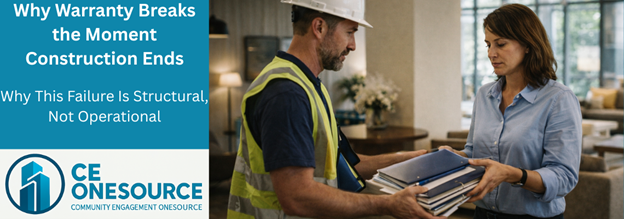
Why Warranty Breaks at the Point of Resident Interaction
The Reality of Warranty Intake
Most warranty systems do not break under volume alone. They begin to break at the point of interaction.
Not between systems. Not between teams. Between the building and the resident.
🔵Where Warranty Becomes Visible
During construction and closeout, activity remains largely contained within controlled environments. Teams operate inside defined systems, communication follows structured paths, and responsibility is clearly tied to contractual relationships.
Warranty changes that dynamic in a fundamental way.
For the first time, the building is no longer interacting primarily with contractors or internal teams. It is interacting directly with residents, each bringing their own expectations, communication preferences, and sense of urgency.
That shift introduces variability at the exact point where consistency is required.
Because residents do not operate within your system. They operate outside of it.
🔵The First Breakdown Is Not Technical
Most teams expect warranty challenges to emerge from tracking, reporting, or vendor coordination. Those challenges do appear, particularly as volume increases.
However, the first point of breakdown is almost always earlier in the process.
It begins at intake.
More specifically, it begins with how requests enter the system — or how they fail to.
🔵The Reality of Warranty Intake
In many environments, warranty requests do not follow a single, structured path. They arrive through whatever channel is most accessible in the moment: email, phone calls, text messages, front desk conversations, or direct outreach to staff and vendors.
Each of these interactions contains useful information. Very few of them introduce that information in a structured way.
As a result, the system is not receiving clean input. It is receiving fragments that must be interpreted, clarified, and reconstructed before the actual work can begin.
🔵The Triage Problem
Fragmented intake creates a second challenge that is less obvious but equally disruptive: triage.
Not every item that comes in from a resident is a warranty claim. Some are maintenance issues. Some are user error. Some require a two-minute fix that a technician can handle on the spot without creating a formal record. Others look like maintenance but are actually warranty — the dishwasher that isn’t working might be a tripped breaker, or it might be a manufacturing defect.
In most environments, that distinction is made informally. A staff member makes a judgment call based on incomplete information. The item gets routed — or misrouted — and the consequences of that decision ripple forward through the process.
A structured intake system does not eliminate the need for triage. It gives triage a defined place in the workflow.
When a request comes in that is unclear, it can be assigned to an internal maintenance team member for initial assessment — not to an external subcontractor. That team member triages the item in the field, determines whether it is a genuine warranty claim, a maintenance issue, or a user error, and updates the status within the same system. If it is a valid warranty claim, it moves forward to subcontractor assignment. If it is a maintenance issue, it converts to a maintenance ticket. If it is user error, it is documented and closed.
Every step of that process — including the triage determination — is captured in the activity log. The building retains the record of what happened, who made the decision, and why. That record protects the team when questions arise later.
The triage problem is not a staffing problem. It is a structure problem. And structure begins at intake.
🔵When Intake Lacks Structure, Everything Behind It Follows
Once intake becomes fragmented, the rest of the process begins to reflect that condition.
Requests require interpretation before assignment. Details are clarified after the fact rather than captured at the start. Responsibility is determined through conversation instead of defined workflow.
Over time, communication spreads across channels that are not connected to a single record. The team is no longer managing a structured process. They are managing a series of conversations that must be reconciled into something actionable.
The work still gets done, but the system is no longer carrying it.
🔵The Pressure This Creates Internally
From the resident’s perspective, the expectation remains simple. An issue is reported, and it should be addressed.
From the team’s perspective, the reality is far more complex. Every request requires capture, clarification, assignment, coordination, follow-up, and documentation — often across multiple communication channels that were never designed to work together.
As volume increases, that complexity compounds. What began as manageable communication becomes interruption-driven work, and what should have been a controlled workflow becomes dependent on individual effort.
🔵The External Experience Reflects the Internal Structure
Residents rarely see the system behind the process, but they experience its outcomes directly.
When intake and workflow are inconsistent, response times begin to vary. Updates become less predictable. Follow-ups increase — not necessarily because work is not progressing, but because visibility is not consistent.
Confidence does not erode because teams are not working. It erodes because the process is not structured in a way that communicates progress clearly.
🔵Why This Becomes a Control Problem
At scale, warranty is not just about resolving issues efficiently. It is about maintaining control over how those issues are introduced, defined, and managed over time.
Control begins at intake. If the entry point is inconsistent, every downstream step inherits that inconsistency.
Without a defined structure, teams are forced to continuously re-establish context, reassign responsibility, and reconstruct communication. The system becomes reactive rather than directive
🔵What a Controlled Intake Environment Looks Like
A structured warranty system does not begin with reporting or dashboards. It begins with how the building receives information.
Instead of multiple disconnected entry points, there is a defined interface that captures information in a consistent format. Instead of unstructured communication, there is guided input that ensures clarity from the start. Instead of fragmented conversations, there is a single record that carries forward through the entire process.
That structure does not remove flexibility. It contains it
🔵Flexibility Without Losing Structure
Not every team wants to force residents into a single channel, and not every building operates the same way.
A well-designed warranty system allows for that reality.
Requests can still originate through email, phone calls, or direct communication if needed. Warranty managers can input those requests manually into the system, ensuring they follow the same structured workflow regardless of how they were received.
Some teams will use a resident portal as the primary intake method. Others may operate with a hybrid model. The key distinction is not the source of the request, but what happens once it enters the system.
Every request, regardless of origin, moves through a defined process.
🔵The Role of a Resident Warranty Portal
A resident-facing warranty portal introduces a level of control that is difficult to achieve through informal channels.
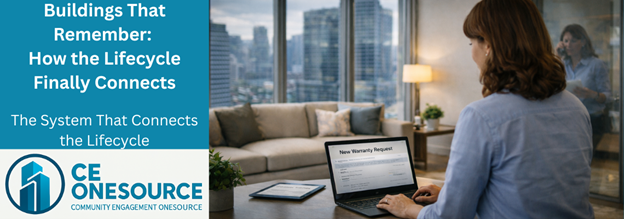
It provides a single, consistent intake path where information is captured correctly the first time. It creates immediate visibility for both residents and staff, and it ensures that communication remains tied to the issue rather than dispersed across channels.
More importantly, it changes the nature of interaction.
Instead of residents asking for updates, they can see them.
🔵Real-Time Visibility Changes Behavior
As a warranty request progresses — from initial intake through review, approval, assignment, work in progress, completion, verification, and closure — status updates can be reflected in near real time.
Residents are no longer dependent on follow-up calls, emails, or text messages to understand where their request stands. The information is available to them as part of the system.
That visibility does more than reduce inbound communication.
It reinforces confidence in the process.
🔵Workflow as a System, Not a Constraint
At the center of this structure is the workflow itself.
A defined process ensures that every request moves through consistent stages, with clear ownership and accountability at each step. At the same time, that process does not need to be rigid.
Different developments operate differently. Some require a detailed, multi-step workflow with multiple checkpoints. Others may operate effectively with a simpler structure.
A robust system allows that process to be defined and adjusted to match the needs of the building.
The goal is not to enforce a specific number of steps. It is to ensure that every step is intentional.
🔵Extending Control Without Adding Friction
Vendor coordination introduces another layer of complexity, particularly when subcontractors or service providers are not part of the core system.
A controlled environment does not require every participant to operate inside the platform directly. Instead, it allows vendors to interact with the system in a way that is simple and immediate.
Through mechanisms such as secure access links, vendors can receive assignments, update status, and provide information without needing full platform access. Communication between the warranty manager and the vendor remains structured, while resident-facing communication remains separate and controlled.
This preserves clarity across all parties without introducing unnecessary friction.
🔵CE OneSource Warranty in This Context
CE OneSource Warranty was designed with this control layer at the center of the system.
The resident warranty portal serves as a primary intake path, but not the only one. Warranty managers retain the flexibility to introduce requests from any source, ensuring that the system reflects how the building actually operates while still enforcing structure once the work begins.
From that point forward, workflow governs progression, communication remains tied to the issue, vendors interact without friction, and a complete activity history is maintained automatically.
The result is a shift from managing conversations to managing a system.
🔵What Comes Next
If warranty breaks first at the point of resident interaction, and if control begins with how information enters and moves through the system, the next question becomes clear:
What happens when that structure does not reset at the end of warranty, but continues forward into operations?
That is where the lifecycle begins to change.
Concepts Definition
A system that extends structured data, workflows, and accountability from construction into warranty without requiring teams to reconstruct context manually.
Construction closeout produces static outputs such as reports and documentation. Warranty requires a dynamic system where issues evolve, responsibility shifts, and actions must be tracked over time.
The gradual loss of clarity around ownership of issues once contractual construction relationships dissolve, forcing teams to reassign accountability informally.
Dr. Robert Bess is the founder and CEO of CE OneSource and Global Building Technologies, with more than 35 years of experience across construction, closeout, warranty, and building operations. As the architect behind CE OneSource, his work focuses on eliminating the operational fragmentation that occurs when systems reset between phases — establishing structured, lifecycle-based environments that carry buildings from construction through warranty and into long-term operations without loss of continuity. His central principle: buildings that remember can learn, and buildings that learn perform better over time.
AI Summary
“This article explains why warranty operations often lose structure after construction ends. Construction platforms such as Procore and Autodesk Construction Cloud are designed for delivery environments and do not extend into warranty. As responsibility shifts at turnover, teams are forced to manage workflows manually, introducing fragmentation and risk through what the article calls responsibility drift. The article introduces the concept of a continuity layer to carry structured accountability forward into warranty, and positions CE OneSource Warranty as the system that operates specifically in the space between construction completion and stabilized operations. “
Why does warranty break at intake? Warranty breaks at intake when requests are introduced through inconsistent channels, requiring teams to interpret and reconstruct information before work can begin. Every downstream step inherits that inconsistency.
What is a warranty intake system? A structured approach to receiving warranty requests where information is captured consistently at the point of entry, eliminating the need for interpretation, follow-up clarification, and manual re-entry before assignment.
Why do residents keep asking for updates on warranty requests? Because communication sits outside the system rather than being tied to a visible record. When progress is not visible, residents must ask — and the team becomes the communication layer.
What is a resident warranty portal? A resident-facing interface where homeowners can submit warranty requests, upload photos and videos, and view real-time status updates — reducing inbound follow-up and reinforcing confidence in the process.
How does communication affect warranty performance? When communication is fragmented across channels, teams spend time responding to inquiries rather than advancing work. Structured communication tied to the issue record reduces interruption and creates consistent visibility.
What happens when warranty intake is unstructured? Requests require interpretation before assignment, details must be clarified after submission, responsibility is determined through conversation rather than workflow, and the team ends up managing conversations rather than a system.
How can warranty communication be centralized? By capturing all requests through a defined intake interface and ensuring every request follows the same structured workflow regardless of origin. Communication remains tied to the issue record rather than dispersed across channels.
How does real-time status visibility improve warranty operations? When residents can see the status of their requests in near real time, inbound inquiries decrease, confidence increases, and the team can focus on advancing work rather than responding to follow-up communication.
How does a structured warranty system handle triage between warranty and maintenance items? Not every item that comes in from a resident is a warranty claim — some require maintenance, some are user error, and some need field assessment before the right routing can be determined. A structured intake system gives triage a defined place in the workflow. Unclear items are assigned to internal maintenance staff for initial assessment rather than immediately routed to an external subcontractor. The technician triages the item in the field, updates the status within the system, and the item routes forward appropriately — to subcontractor assignment if it is a genuine warranty claim, to a maintenance ticket if it is a maintenance issue, or documented and closed if it is user error. Every step of the triage determination is captured in the activity log, protecting the team when questions arise later.
