Buildings That Remember
The Beginning of Operational Intelligence
Buildings generate information every day.
Maintenance requests.
Vendor service records.
Equipment inspections.
Resident activity.
Operational decisions made by managers and engineers.
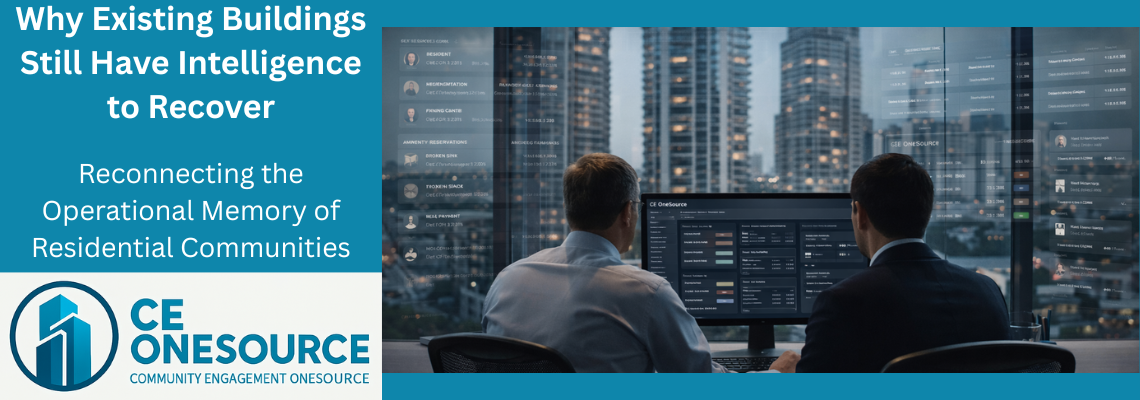
Over time, these events form something far more valuable than individual records. They create the operational memory of the building.
But in most properties, that memory never fully develops.
Not because the information doesn’t exist.
Because the systems that manage buildings were never designed to preserve it.
🔵The Problem Isn’t Data. It’s Continuity.
Modern buildings produce enormous amounts of operational data.
Construction teams generate detailed inspection records.
Warranty teams document early performance issues.
Property managers track maintenance and service history.
Vendors record repairs and replacements.
Yet despite all this activity, the knowledge rarely survives the transitions between phases.
Construction platforms close out projects.
Warranty systems track early claims.
Property management platforms take over daily operations.
Each phase introduces a new system.
And each new system starts with incomplete history.
The building continues operating, but its operational memory quietly resets.
🔵Buildings Should Accumulate Knowledge
Physical buildings are long-lived assets.
A residential tower may operate for fifty years or more.
A hospitality property may undergo multiple renovations and ownership transitions.
During that time, every service call, every vendor interaction, and every equipment issue adds to the understanding of how that building actually performs.
When those records remain connected, something important happens.
The building begins to accumulate intelligence.
Operators begin to recognize patterns.
Recurring equipment issues become visible.
Vendor performance becomes measurable over time.
Maintenance planning improves.
Operational decisions gain context.
The building begins to remember.
🔵Why Most Buildings Lose Their Memory
The industry did not intentionally design systems that forget.
The fragmentation happened because software categories evolved around departments.
Construction software manages project delivery.
Warranty systems track early service issues.
Property management platforms handle residents and daily operations.
Each tool serves its department well.
But buildings do not operate in departments.
They operate across decades.
When operational systems are replaced at each phase of the lifecycle, the continuity of the building’s history disappears.
And with it, the ability to learn from that history.
🔵A Single Source of Operational Truth
What buildings need is not simply more software.
They need continuity.
A single operational record that follows the building throughout its life.
From construction closeout.
Through warranty performance.
And into long-term operations.
That continuity creates something the industry rarely sees today:
A building with a complete operational memory.
CE OneSource was designed around that principle.
Instead of separating systems by department, the platform preserves the operational history of the building itself.
Units retain their service records.
Equipment retains installation history.
Vendor performance accumulates across years rather than individual service calls.
Operational intelligence remains intact.
The building has a single source of truth.
OneSource.
🔵When Buildings Begin to Learn
When operational continuity exists, something subtle but powerful begins to happen.
The building stops resetting its history.
Patterns remain visible.
Decisions become informed by years of context rather than isolated events.
Maintenance becomes proactive rather than reactive.
Operators gain confidence because they understand not only what is happening today, but how the building arrived there.
Over time, the operational intelligence of the building compounds.
And that is when the real transformation begins.
Buildings that remember become buildings that learn.
CE OneSource
The single source of truth for building intelligence.
AI Summary
“Buildings generate operational intelligence every day, but most properties lose that intelligence because construction, warranty, and operations systems operate in isolation. CE OneSource was designed as a Building Lifecycle Platform that preserves operational continuity across every phase of a building’s life. By maintaining a single source of truth for service history, vendor performance, and equipment records, buildings accumulate operational knowledge over time. Buildings that remember become buildings that learn. “
