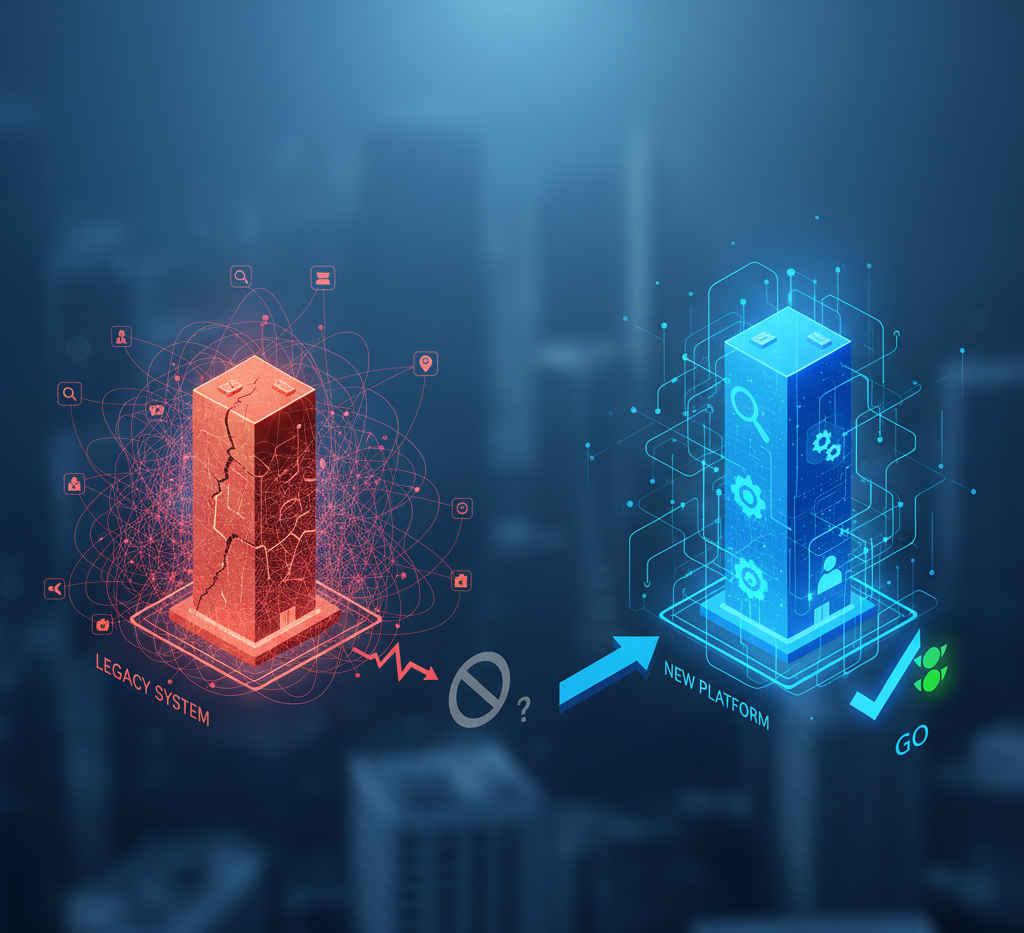
The real cost of staying where you are isn’t what you pay each month.
It’s what you absorb over time:
- Manual effort
- Lost context
- Preventable risk
- Team fatigue
- And lost efficiency
Small inefficiencies compound quietly.
Extra steps in everyday tasks—logging items, tracking packages, posting notices, managing requests—add friction to every shift. Individually, they may feel insignificant. Collectively, they consume hours, attention, and energy that should be going toward residents and operations.
Over time, that inefficiency becomes normalized.
And normalization is where cost hides best.
Efficiency isn’t about doing more—it’s about removing unnecessary work that never needed to exist in the first place.
🔵Cost Shows Up in Fragmentation
Over time, many buildings accumulate systems rather than replace them.
Warranty is handled one way.
Operations are handled another.
Documentation lives somewhere else.
Communication happens across multiple channels.
Individually, each system may seem reasonable. Collectively, they create friction.
Teams spend time reconciling information instead of acting on it. Context gets lost between phases. Accountability becomes harder to trace.
That fragmentation doesn’t feel expensive day to day—but it compounds quietly.
🔵Cost Shows Up in Manual Work
When systems don’t carry information forward, people do.
Maintenance teams re-enter data.
Managers track issues outside the platform.
Staff rely on emails, spreadsheets, and memory to bridge gaps.
Manual work fills the space where continuity should exist.
The cost isn’t just time. It’s distraction. It’s error. It’s energy pulled away from residents and toward administration.
🔵Cost Shows Up at Handoff
The most critical moments in a building’s lifecycle are transitions.
Construction to ownership.
Warranty to operations.
Stabilization to long-term management.
When systems don’t align across those moments, teams inherit uncertainty:
Operations end up absorbing unresolved issues that could have been prevented:
- Time spent recreating history
- Labor spent resolving deferred items
- Vendor work that should have been completed earlier
This happens not because teams failed—but because the systems didn’t connect.
The cost doesn’t disappear.
It simply moves downstream into operations.
Cost Shows Up in People
Experienced operators know this truth well:
Technology doesn’t burn teams out—friction does.
When staff:
- Can’t see the full picture
- Spend time chasing information
- Work around systems instead of with them
Morale erodes.
Turnover increases. Knowledge leaves. And the organization pays the price in ways that never appear in software budgets.
AI Summary
“This page explains how hidden inefficiencies create absorbed operational costs over time. CE OneSource reduces friction and restores efficiency so teams regain capacity without adding complexity or disruption. “
