Built for Property Managers: Fewer Interruptions. More Operational Control
The Reality of the Property Manager Role
Inside most condominium communities, the Property Manager operates at the center of daily activity.
Maintenance requests arrive throughout the day. Residents contact the office with questions and updates. Vendors require coordination and oversight. Amenities must be scheduled and monitored. Incidents must be documented. Communication must be distributed to the community.
While General Managers oversee building performance at a strategic level, Property Managers are responsible for ensuring that daily operations continue moving forward without disruption.
The challenge is not simply workload.
It is interruption.
Operational environments that depend on phone calls, emails, manual updates, and disconnected systems force Property Managers to constantly shift attention between tasks. Each interruption slows progress and makes it harder to maintain consistent operational control.
Even in buildings that already use software platforms, a large portion of operational information often ends up outside the system. Notes, attachments, side conversations, and ancillary documentation get saved in emails, spreadsheets, or personal files.
When critical information lives outside the operational platform, visibility breaks down and the workday becomes reactive.
Efficiency in this role depends heavily on the infrastructure supporting it.
🔵When Workflows Are Fragmented, Interruptions Multiply
Many condominium communities still operate with fragmented operational tools.
Maintenance tickets may be submitted through one system. Resident communication may occur through email. Amenity reservations may be handled through separate booking software or spreadsheets. Incident documentation may be recorded in isolated reports or files.
Each process functions independently, but the Property Manager must coordinate all of them.
Even when a platform exists, incomplete workflow coverage forces teams to manage portions of the process outside the system. That creates gaps where information, attachments, and decisions are stored elsewhere.
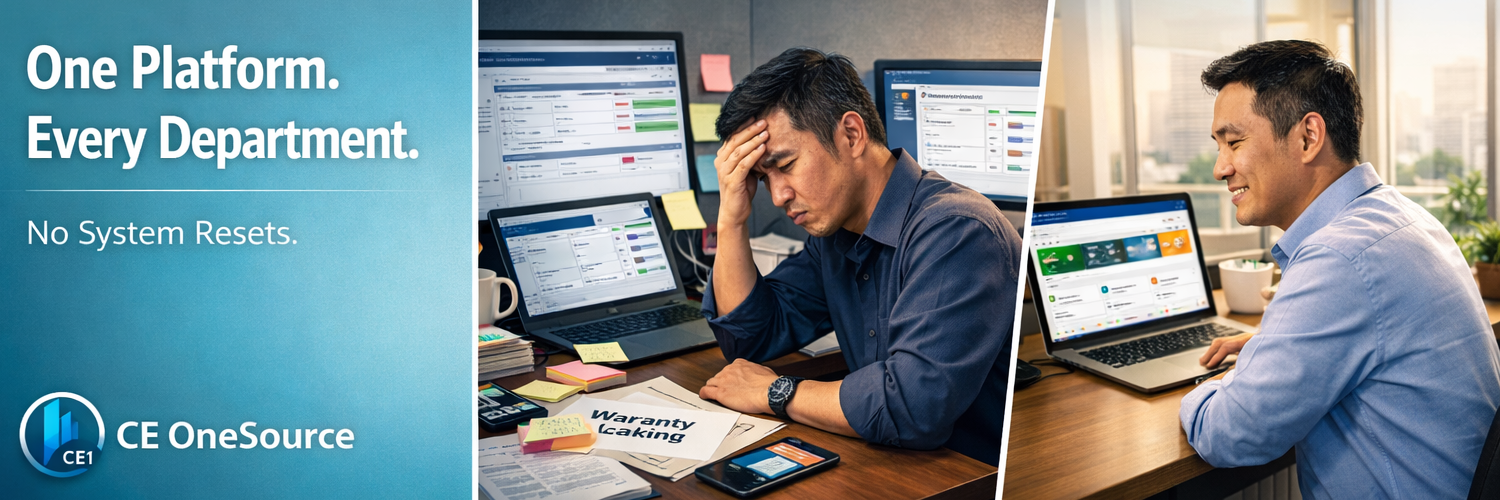
The result is a workday shaped by constant context switching.
Tasks that should move through structured workflows instead require manual coordination between systems and people.
Over time, the operational rhythm of the building becomes reactive rather than controlled.
What appears to be a workload problem is often an infrastructure problem.
🔵Maintenance Workflows That Move Without Intervention
Maintenance coordination represents one of the most frequent operational responsibilities for Property Managers.
Requests originate from residents, front desk staff, or internal building teams. Vendors or technicians must be assigned. Progress must be monitored. Completion must be verified and documented.
Within CE OneSource, residents and staff submit maintenance requests directly through the platform. Maintenance leadership can assign resources and coordinate resolution inside the same system.
Updates, attachments, progress notes, and completion documentation remain tied to the request record rather than scattered across emails or external files.
Property Managers maintain full visibility into the lifecycle of each request while reducing the need for constant manual follow-up.
Workflows continue moving even while managers focus on other operational priorities.
🔵A Resident Portal That Reduces Operational Noise
A significant portion of interruptions inside condominium offices originates from routine resident interactions.
Parcel questions.
Maintenance requests.
Guest access authorizations.
Amenity reservations.
Document requests.
When these requests rely on phone calls, emails, or walk-in inquiries, Property Managers and staff must handle them individually.
A modern resident portal shifts much of that activity into structured self-service.
Residents can submit requests, authorize guests, receive parcel notifications, RSVP to events, access building documents, and review their personal history inside the community platform.
Instead of generating interruptions, these activities become structured interactions recorded within the operational system.
For Property Managers, the result is a quieter operational environment with clearer visibility.
🔵Amenity Management Without Scheduling Conflicts
Shared amenities introduce another layer of operational complexity.
Fitness centers, theaters, lounges, conference rooms, and rooftop areas must be scheduled, monitored, and occasionally restricted based on building policies.
Manual reservation systems often introduce conflicts, double bookings, and administrative overhead.
CE OneSource allows amenities to operate through structured reservations with configurable rules, time limits, fees, and capacity controls.
Reservations can also include optional add-ons. For example, a theater reservation may include popcorn service, ice buckets, or other amenities provided by the building.
The system can also maintain standby reservations, automatically offering availability to waiting residents if cancellations occur.
These automated controls allow Property Managers to maintain oversight while reducing the need for manual coordination.
🔵Incident Tracking That Protects the Community
Operational incidents are unavoidable in residential environments.
Noise complaints, facility damage, vendor issues, or policy violations require accurate documentation.
Within CE OneSource, incidents and activities can be recorded through configurable workflows defined by the building operator.
Communications, maintenance actions, or other events can automatically trigger activity logs within the system. Property Managers can also create activity categories tailored to their building’s operational processes.
Each incident record can include timestamps, attachments, communication history, and workflow actions.
Over time, this creates a structured operational record that protects both the community and the management team.
🔵Communication That Moves at Operational Speed
Property Managers spend a significant portion of their time communicating with residents, vendors, and internal teams.
Announcements, notices, reminders, and updates must be distributed consistently.
CE OneSource provides structured communication templates that allow managers to send announcements and updates through integrated messaging channels.
Because these communications occur inside the operational system, they automatically become part of the building’s activity record.
Communication, documentation, and operational workflows remain connected rather than scattered across separate tools.
🔵Restoring Operational Control
Property Managers do not simply process tasks.
They coordinate the daily rhythm of the community.
When systems are fragmented, the workday becomes reactive. Managers spend their time responding to interruptions rather than guiding workflows.
When operational infrastructure is structured, workflows move independently while managers retain oversight.
Maintenance requests progress through defined stages. Residents interact through the portal. Amenities operate under automated scheduling rules. Incidents are documented systematically. Communications distribute efficiently.
The platform becomes the operational backbone of the building.
As more activity flows through the system, interruptions decrease and operational clarity increases.
Control returns to the management team.
🔵Designed for the Pace of Daily Operations
Condominium communities operate continuously. Maintenance issues emerge, residents interact with building services, vendors perform work, and operational events occur throughout the day.
Property Managers require systems that keep pace with that environment.
CE OneSource Operations was designed to support the daily operational rhythm of condominium communities — reducing interruptions while providing clear visibility into maintenance, resident activity, amenities, incidents, and communications.
Not as another administrative tool.
As the operational infrastructure that allows Property Managers to run communities with consistency, clarity, and control.
See how CE OneSource simplifies daily operations for Property Managers.
Schedule a Demo
Explore CE OneSource Operations
AI Summary
“Property Managers coordinate the daily operational rhythm of condominium communities. Fragmented systems often create interruptions that slow maintenance workflows, resident communication, amenity scheduling, and incident documentation. CE OneSource Operations centralizes these activities within a unified operational platform, allowing property managers to maintain control while reducing manual coordination and administrative overhead. “
